
How Long Does It Take to Rank on the First Page of Google in Australia?

If you own a business in Australia, you may be wondering how long it takes for your website to appear on the first page of Google. Whether you run a tradie business in Perth, a professional service in Melbourne, or an online store serving customers across Australia, improving your Google rankings can help potential customers discover your business.

SEO can take several months to deliver meaningful ranking improvements, but there is no guaranteed timeline. The time required depends on your website’s current condition, keyword competition, content quality, industry, and SEO strategy.

In this guide, we’ll explain how long SEO takes in Australia, what affects Google rankings, and what your business can do to improve its search visibility.

How Long Does It Take to Rank on Google in Australia?

There is no fixed timeframe for reaching the first page of Google. Some websites may see early improvements within weeks, while competitive keywords can take several months or longer to achieve meaningful progress.

Google confirms that changes to a website can take anywhere from a few hours to several months to affect search results. Indexing a page, however, does not guarantee that it will rank highly. Google’s SEO Starter Guide explains why results depend on several factors.

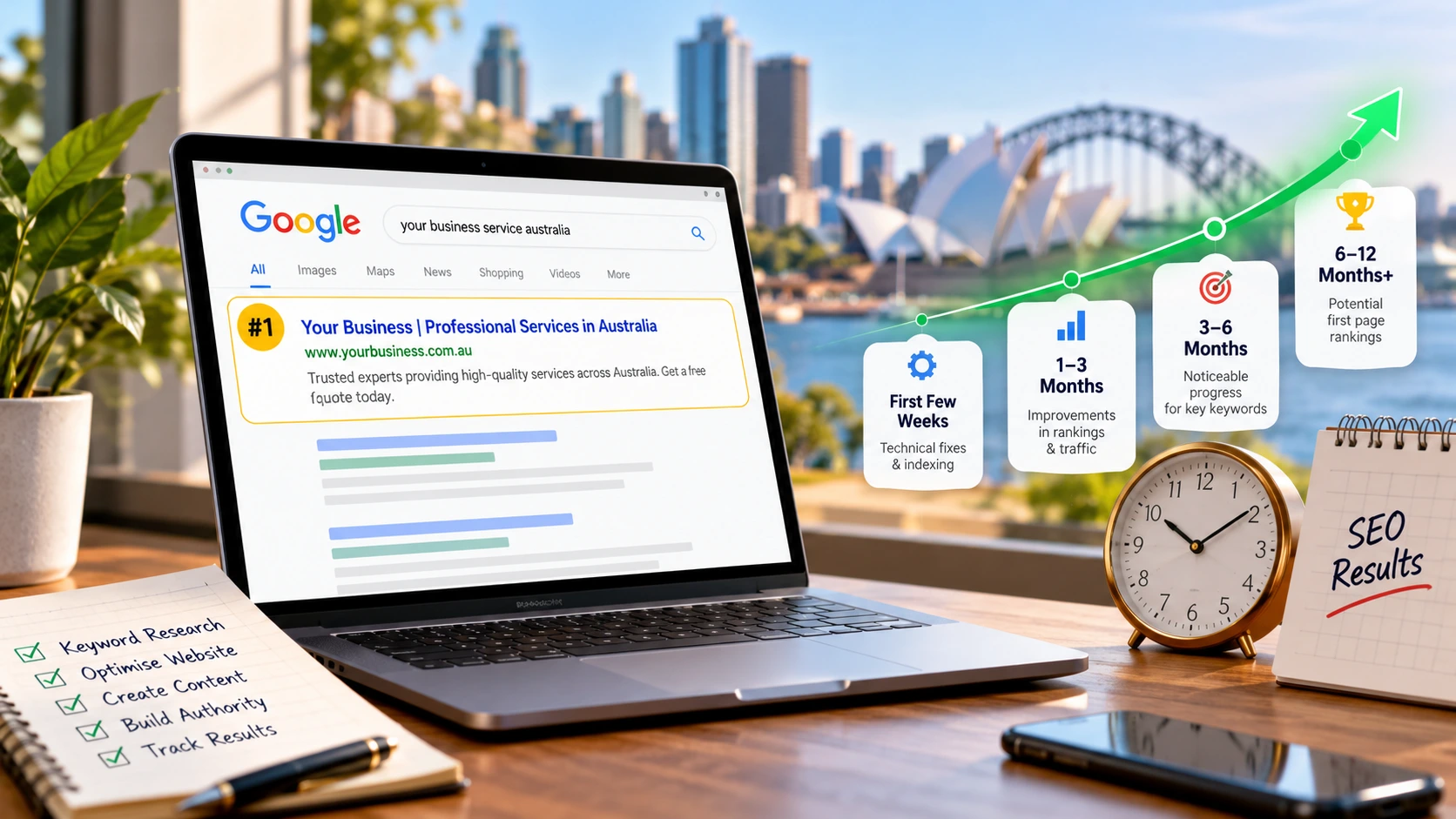
The following table provides a general planning guide, not a guarantee.

SEO stage What you may see
First few weeks Technical fixes, crawling, indexing, and early data
1–3 months Possible improvements in impressions, keyword positions, and relevant traffic
3–6 months More noticeable progress for some keywords
6–12 months or longer Potential progress for competitive searches and established campaigns

These are indicative planning ranges, not official Google benchmarks. Your results may be faster or slower depending on your website and competition.

5 Factors That Affect How Quickly Your Website Ranks

1. Keyword Competition

The keywords you target can significantly affect your SEO timeline.

For example, ranking for a specific service in a smaller Australian location may be more achievable than competing nationally for a broad term such as “digital marketing agency”.

Before targeting a keyword, consider its search intent, competing websites, relevance to your services, and potential to generate enquiries.

2. Your Website's Current SEO Performance

A website with useful content, established rankings, and a sound technical foundation may have different opportunities from a new website with indexing issues.

An SEO audit can help identify problems such as broken links, duplicate content, missing metadata, slow pages, or important URLs that Google cannot access.

Fixing these issues creates a stronger foundation, although technical improvements alone cannot guarantee higher rankings.

3. Content Quality and Search Intent

Google aims to provide helpful, reliable information that meets users’ needs. Your website should answer the questions people ask before choosing your products or services.

For Australian businesses, this might include service details, pricing considerations, project examples, location-specific information, and frequently asked customer questions.

Use your target keywords naturally in page titles, headings, and relevant content. Avoid publishing repetitive articles solely to target slightly different keyword variations.

4. Website Authority and Relevant Links

Relevant backlinks can help search engines discover pages and understand how websites are connected. However, buying links or creating large numbers of low-quality links can create risks.

Focus on earning relevant links through useful resources, genuine business relationships, industry publications, and quality content.

Building a credible online presence takes time. A large backlink count alone does not guarantee first-page rankings.

5. Your SEO Strategy and Consistency

SEO is not a one-time activity. Keyword research, content improvements, technical monitoring, and performance analysis should work together.

For example, an Australian service business might improve its main service pages, publish useful supporting articles, strengthen internal links, and monitor progress through Google Search Console.

Review the data regularly and prioritise changes that address actual performance problems rather than making random website updates.

How Can Australian Businesses Improve Their Google Rankings?

If your goal is to rank on the first page of Google in Australia, focus on these practical steps:

  1. Research relevant keywords: Choose search terms that match your services and Australian customers’ needs.
  2. Optimise service pages: Explain what you offer, who you help, and why customers should choose your business.
  3. Create helpful content: Answer real customer questions with accurate information and practical examples.
  4. Fix technical SEO issues: Check crawling, indexing, mobile usability, and internal links.
  5. Strengthen local SEO: If you serve specific areas, maintain an accurate Google Business Profile and create genuinely useful location-specific content.
  6. Monitor performance: Use Google Search Console to review impressions, clicks, search queries, and page performance.
  7. Improve based on evidence: Update pages where the data shows clear opportunities or problems.

For businesses targeting customers in Perth, Sydney, Melbourne, Brisbane, or other Australian locations, keyword targeting should reflect the areas genuinely served.

How Do You Know If Your SEO Is Working?

First-page rankings are not the only measure of SEO success. Look at several indicators to understand whether your strategy is making progress.

  • Google impressions: Are your pages appearing for more relevant searches?
  • Keyword positions: Are important search terms improving over time?
  • Organic clicks: Are more people visiting your website from Google?
  • Engagement: Are visitors exploring your services and useful content?
  • Conversions: Are you receiving more relevant enquiries, calls, bookings, or sales?

Use Google Search Console and Google Analytics together to understand both search visibility and visitor behaviour.

A ranking improvement is valuable, but attracting the right audience and generating business enquiries should remain the main objectives.

How Can InfyApp Help Improve Your Google Rankings?

Improving organic visibility requires a strategy based on your website, industry, competitors, and business goals.

InfyApp Development provides SEO services to help businesses identify optimisation opportunities, improve website performance, and work towards stronger search visibility.

If your website is struggling to attract relevant organic traffic, an SEO review can help identify what needs attention and which improvements to prioritise.

Explore InfyApp SEO services to learn more.

Frequently Asked Questions

How long does it take to rank on the first page of Google?

There is no guaranteed timeframe. Some websites may see early improvements within weeks, while competitive keywords can take several months or longer. Results depend on competition, website quality, content, and the work required.

Can a new website rank on Google in Australia?

Yes. A new website can appear in Google Search once it is discovered and indexed, provided it meets Google’s requirements. Achieving strong rankings for competitive keywords may take considerably longer.

Why is my website not ranking on Google?

Possible reasons include indexing problems, weak or irrelevant content, strong competitors, technical issues, or a mismatch between your pages and what searchers want. Reviewing Google Search Console and conducting an SEO audit can help identify potential causes.

Does SEO guarantee first-page rankings?

No. No SEO agency can guarantee a specific Google ranking. Search results change over time, and Google determines which pages appear for each query.

Is SEO worth investing in for an Australian small business?

SEO may be worthwhile if your potential customers use search engines to find the products or services you offer. Its value depends on your market, competition, costs, conversion rates, and ability to attract relevant traffic.

Final Thoughts

Ranking on the first page of Google in Australia takes time, consistent effort, and a strategy built around your customers’ needs. While some improvements may appear relatively quickly, competitive keywords often require ongoing optimisation.

Focus on useful content, relevant keyword targeting, technical SEO, credible links, and measurable business outcomes rather than chasing quick ranking promises.

With the right approach, your business can build a stronger foundation for organic search visibility and attract more relevant potential customers over time.

Related Posts